





Most people associate the Fourth Amendment with police searches, arrests, and criminal investigations. However, its protections extend into many everyday situations, including traffic stops, encounters with law enforcement, searches of personal belongings, and questions about whether officers can enter a home. Understanding these constitutional rights can make a significant difference when an ordinary interaction with police becomes a criminal investigation.
For individuals facing criminal charges in California, the Fourth Amendment is particularly important because it establishes limits on how law enforcement can search for evidence, seize property, and detain individuals. When officers exceed those limits, the legality of the evidence they collect may become an important issue in a criminal defense case.
At Grech, Packer & Hanks, we understand that many people have little experience with the criminal justice system until they find themselves under investigation or facing charges. Knowing how Fourth Amendment rights apply to common situations can help individuals recognize potential constitutional violations and understand why the circumstances surrounding a police encounter matter.
What Does the Fourth Amendment Actually Protect?
The Fourth Amendment to the United States Constitution protects individuals against unreasonable searches and seizures by the government. Its purpose is to prevent law enforcement from intruding into private spaces, examining personal property, or restricting an individual’s freedom without adequate legal justification. These protections apply to federal, state, and local law enforcement, including police officers throughout California.
The amendment does not prohibit every search or seizure. Instead, it requires government actions to meet constitutional standards of reasonableness. Depending on the circumstances, officers may need a warrant, probable cause, reasonable suspicion, or valid consent before taking certain actions. The legal requirements vary based on what officers are attempting to do and where the encounter occurs.
The Fourth Amendment’s constitutional text also establishes requirements for search warrants. Warrants generally must be supported by probable cause, backed by an oath or affirmation, and describe the place to be searched and the persons or things to be seized with sufficient particularity.
These protections are important because a Fourth Amendment violation can affect the admissibility of evidence in a criminal case. However, not every constitutional violation automatically results in dismissed charges or excluded evidence. Courts examine the circumstances and applicable legal exceptions before determining the appropriate remedy.
The Difference Between Reasonable Suspicion and Probable Cause
Two important concepts in Fourth Amendment law are reasonable suspicion and probable cause. Although they are related, they establish different levels of justification for police activity. Understanding the distinction helps explain why an officer may legally stop someone without necessarily having sufficient grounds to arrest that person.
Reasonable suspicion generally allows an officer to briefly detain someone when specific, articulable facts suggest that criminal activity may be occurring. It requires more than an unsupported hunch, but less evidence than probable cause. For example, an officer who observes behavior consistent with a particular crime may have grounds to conduct a limited investigation. The detention must remain reasonably related in scope and duration to its justification.
Probable cause is a higher standard generally required for arrests and many searches. It exists when the facts and circumstances would lead a reasonable person to believe that a crime has occurred or that evidence of a crime will be found in a particular location. Probable cause does not require proof beyond a reasonable doubt, but it must rest on objective circumstances.
The distinction becomes especially important when a police encounter escalates. An officer may initially have sufficient grounds to question someone briefly but lack the legal justification necessary for an arrest or a more intrusive search. A California criminal defense attorney can examine whether the officer’s actions remained within constitutional limits as the encounter developed.
Fourth Amendment Rights During Traffic Stops
Traffic stops are among the most common situations in which people encounter Fourth Amendment protections. When an officer pulls over a vehicle, the driver and passengers are generally considered seized for constitutional purposes because they are not free to leave. Officers ordinarily need a lawful basis for initiating the stop, such as reasonable suspicion of a traffic violation or other criminal activity.
A lawful traffic stop does not automatically authorize a search of the entire vehicle. Officers may request a driver’s license, registration, and proof of insurance, investigate the reason for the stop, and perform certain related checks. However, extending the detention to investigate unrelated criminal activity generally requires additional legal justification, unless the extension is otherwise lawful.
Vehicle searches involve separate considerations. Under the automobile exception, police may search areas of a vehicle where evidence could reasonably be found when they have probable cause to believe the vehicle contains contraband or evidence of a crime. Officers may also conduct certain limited protective searches when specific safety concerns justify them.
For example, a routine speeding stop does not automatically give an officer authority to open the trunk and inspect its contents. Whether a warrantless vehicle search is lawful depends on the circumstances, including consent, probable cause, and other recognized exceptions. These details can become central when evidence discovered during a traffic stop leads to criminal charges.
When Police Can Enter or Search Your Home
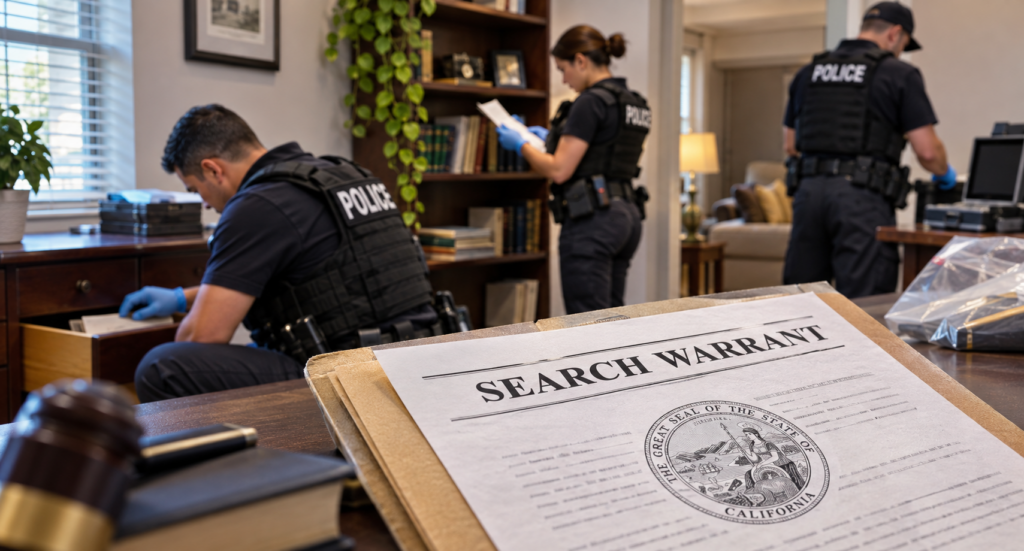
The home receives particularly strong protection under the Fourth Amendment. In most circumstances, law enforcement must obtain a valid search warrant before entering a residence to conduct a criminal investigation. A warrant typically identifies the location officers are authorized to search and the evidence they are permitted to seek.
However, several exceptions may permit entry without a warrant. These include voluntary consent and certain exigent circumstances, such as an immediate emergency requiring assistance, an imminent threat to safety, or a genuine risk that evidence will be destroyed. Whether an exception applies depends on the specific facts rather than an officer’s general belief that a crime may have occurred.
Consent is especially important. If someone with actual or apparent authority voluntarily permits officers to enter, a search may be lawful without a warrant. However, individuals generally have the right to decline a request for consent when officers lack independent legal authority to enter. The scope of any consent also matters because permission to enter one area does not necessarily authorize searching every room or personal belonging.
When criminal charges result from a police search of a home, defense attorneys may examine the warrant, the information supporting it, the officers’ conduct, and whether any exception justified a warrantless entry. Evidence discovered outside the legally authorized scope of a search may raise additional constitutional questions.
Fourth Amendment Protections for Cell Phones and Digital Information
Cell phones contain substantial amounts of personal information, including photographs, messages, emails, financial records, and location histories. Because these devices can reveal intimate details about someone’s life, courts recognize significant privacy interests in their contents. The Fourth Amendment therefore applies to many situations involving digital evidence and electronic searches.
As a general rule, police must obtain a warrant before searching digital information stored on a cell phone seized during an arrest. Certain exceptions may apply, including valid consent or genuine emergency circumstances. The fact that officers lawfully possess a phone does not automatically authorize them to examine its contents.
Digital investigations may also involve information stored by third parties, including communication providers. Different legal standards can apply depending on the information requested and how it is obtained. For example, historical cell-site location records can reveal a person’s movements over time and generally require a warrant when sought by law enforcement.
These issues are particularly relevant in white collar crime investigations, fraud cases, and other prosecutions involving electronic communications. Defense attorneys may examine how investigators obtained digital evidence, whether proper legal authorization existed, and whether the search exceeded its permitted scope.
Your Rights During Police Encounters in Public Places
Not every conversation with a police officer constitutes a detention. Officers may approach individuals in public places, ask questions, or request information without necessarily triggering Fourth Amendment restrictions. A key distinction is whether a reasonable person would feel free to decline the interaction or leave under the circumstances.
If officers restrict someone’s freedom of movement through physical force or a show of authority to which the person submits, the encounter may become a detention. At that point, officers generally need appropriate legal justification. A brief investigative detention ordinarily requires reasonable suspicion, while an arrest generally requires probable cause.
Police may also conduct a limited pat-down for weapons during a lawful investigative stop when they reasonably suspect the individual is armed and dangerous. However, this protective search is not the same as a general search for evidence. Its purpose and permissible scope are limited.
Understanding detention versus arrest is important because the legal requirements change as an encounter progresses. Individuals should remain calm, avoid physical resistance, and clearly communicate when they do not consent to a requested search. Whether they must identify themselves or comply with other instructions depends on the applicable law and circumstances.
What Happens When Fourth Amendment Rights Are Violated?
When evidence is obtained through an unconstitutional search or seizure, a criminal defense attorney may challenge its admissibility. In California, Penal Code Section 1538.5 establishes procedures for requesting the suppression of evidence obtained through unlawful government conduct.
A motion to suppress evidence asks the court to determine whether particular evidence was obtained in violation of constitutional protections and should therefore be excluded. Depending on the circumstances, the challenge may concern an unlawful traffic stop, an improperly executed search warrant, an unauthorized search of a residence, or an unconstitutional detention.
Successful suppression can significantly affect a criminal prosecution, particularly when the challenged evidence forms a substantial part of the prosecution’s case. However, exceptions to the exclusionary rule may apply, and suppression does not automatically require dismissal of the charges.
At Grech, Packer & Hanks, we carefully evaluate the legality of law enforcement procedures, the strength of the prosecution’s evidence, and the circumstances surrounding an arrest or investigation. Identifying potential unlawful search and seizure issues is an important part of developing an effective criminal defense strategy.
Frequently Asked Questions About Fourth Amendment Rights
Fourth Amendment protections can be difficult to understand because their application depends on specific circumstances. The following questions address additional concerns individuals may have when interacting with law enforcement.
Does the Fourth Amendment protect me if I am not a United States citizen?
Yes. Fourth Amendment protections generally extend to people within the United States regardless of citizenship status, although certain immigration, border, and international circumstances involve different legal considerations.
Citizenship alone does not determine whether someone can challenge an unlawful search or seizure. Courts examine the person’s circumstances, privacy interests, and the government conduct involved.
Can police use evidence they discover accidentally during a lawful search?
Sometimes. Under the plain-view doctrine, officers may seize certain evidence they encounter while lawfully present in a location, provided its incriminating nature is immediately apparent and they have lawful access to it.
However, officers cannot automatically expand a search beyond its authorized scope simply because they suspect additional evidence might exist. The circumstances surrounding the discovery remain important.
Do Fourth Amendment protections apply to belongings stored in a hotel room?
Yes. Hotel guests generally have a reasonable expectation of privacy in their rooms during a lawful period of occupancy. Police ordinarily need a warrant or an applicable exception before conducting a search.
However, privacy protections may change when lawful occupancy ends or when other circumstances affect the guest’s expectation of privacy. The facts surrounding the search determine whether constitutional protections apply.
Can I challenge an unlawful search if the property searched belongs to someone else?
Possibly. Fourth Amendment challenges generally depend on whether the individual had a legitimate privacy interest in the place or property searched, rather than ownership alone.
For example, someone may have privacy protections in a location they do not own, while another individual may lack sufficient privacy interests to challenge a particular search. An attorney can evaluate whether the person has grounds to seek suppression.
Facing Criminal Charges After an Unlawful Search? Let Us Defend You!
When law enforcement searches your home, vehicle, personal belongings, or electronic devices, understanding your constitutional protections can be essential to your defense. An unlawful search or seizure may affect the evidence prosecutors can use, but identifying those violations requires careful examination of the facts, police procedures, and applicable law.
At Grech, Packer & Hanks, our award-winning Riverside criminal defense attorneys represent individuals facing serious criminal charges throughout Southern California. We have extensive experience handling complex white collar crime cases, public corruption allegations, insurance fraud, workers’ compensation fraud, and other high-stakes criminal matters. Our team includes a Certified Specialist in Criminal Law, and our attorneys bring experience from hundreds of jury trials to the defense of our clients.
We understand that criminal charges can create tremendous uncertainty for individuals and their families. Our approach includes evaluating the legality of investigative procedures, identifying weaknesses in the prosecution’s evidence, and developing defense strategies based on the specific circumstances of each case. Whether the allegations involve an unconstitutional search, questionable evidence, or another potential violation of your rights, we are committed to providing determined legal representation.
The sooner you act in your defense, the better. If you believe your Fourth Amendment rights were violated or you are facing criminal charges, contact our team to discuss your situation. Call (951) 682-9311 or contact us online to begin protecting your rights and building your defense.