





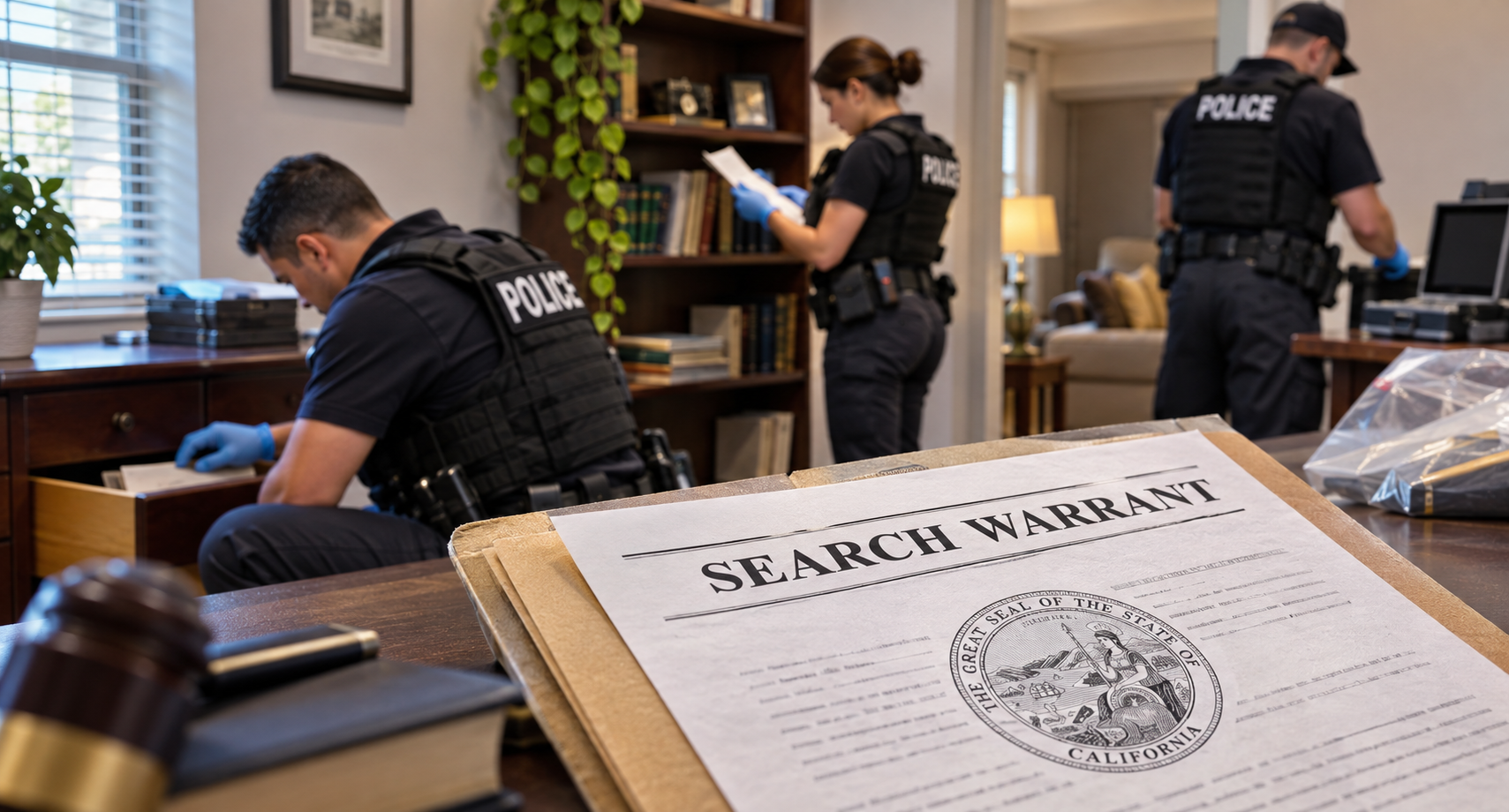
Imagine hearing an unexpected knock at your front door. When you answer, several police officers are standing outside, and one presents a search warrant. They explain that they have legal authorization to enter your home and look for evidence connected to a criminal investigation. You may have questions about why your property is being searched, whether you can refuse entry, and what officers are legally permitted to do.
For many California residents, a search warrant is something they have only encountered on television. However, California search warrant laws establish specific requirements governing how warrants are obtained, what officers may search, and how evidence can be collected. These rules are designed to balance legitimate criminal investigations with constitutional protections against unreasonable government intrusion.
Understanding what police can and cannot do with a search warrant is important, particularly if you are under investigation or facing criminal charges. Knowing how warrants work can help you recognize potential violations of your rights and understand when legal representation may be necessary.
What Is a Search Warrant?
A search warrant is a written court order authorizing law enforcement officers to search a specific location, person, or property for evidence related to an investigation. Under California Penal Code Section 1523, a search warrant directs a peace officer to search for designated persons, property, or things.
Search warrants are governed by the Fourth Amendment of the United States Constitution, which protects individuals against unreasonable searches and seizures. This protection generally requires law enforcement to obtain judicial authorization before searching areas where people have a reasonable expectation of privacy, unless a recognized legal exception applies.
A warrant is not permission for officers to search everything they encounter. It must identify the location to be searched and describe the evidence being sought with sufficient particularity. These requirements help prevent unrestricted searches unrelated to the investigation.
How Do Police Obtain a Search Warrant in California?
Before obtaining a search warrant, investigators must establish probable cause. This means presenting facts sufficient to persuade a judge that there is a fair probability that evidence of a crime will be found in the location officers intend to search.
Officers typically submit a sworn affidavit describing the investigation, the suspected criminal activity, and the connection between that activity and the requested search. The supporting information might include witness statements, surveillance observations, financial records, or other investigative findings.
A judge reviews the application to determine whether the legal requirements have been satisfied. If sufficient probable cause exists, the judge may authorize the search. If the application does not establish the necessary legal grounds, the judge should deny the request.
Importantly, obtaining a warrant does not mean someone has been proven guilty. The probable cause standard required for a search warrant is substantially different from the proof beyond a reasonable doubt required for a criminal conviction.
What Can Police Search With a Search Warrant?
The scope of a search depends primarily on what the warrant authorizes. Officers may generally search the specified location and examine areas where the objects identified in the warrant could reasonably be located.
For example, if officers are searching for financial records connected to suspected fraud, they may be authorized to examine filing cabinets, desk drawers, and other places where those records could be stored. If the warrant authorizes a search for a large stolen appliance, searching a small jewelry box would ordinarily fall outside the reasonable scope of that search.
A search warrant for a home may authorize officers to examine bedrooms, closets, garages, and other areas within the described premises when those locations could contain the specified evidence. However, the precise language of the warrant and surrounding circumstances determine the permissible boundaries.
Officers may also encounter evidence of unrelated criminal activity. Under certain circumstances, the plain-view doctrine allows them to seize evidence discovered while lawfully conducting a search. This exception has specific legal requirements and does not authorize officers to expand a search without justification.
Can Police Search Your Phone, Computer, or Electronic Devices?
Electronic devices create additional legal questions because smartphones, computers, and tablets may contain substantial amounts of private information. Messages, photographs, financial documents, browsing histories, and business communications can all become relevant during criminal investigations.
A warrant authorizing the seizure or examination of electronic devices must satisfy applicable constitutional requirements. Digital search warrants may identify particular devices, accounts, records, or categories of information investigators are authorized to examine.
For example, a warrant involving suspected insurance fraud might authorize investigators to search electronic records associated with certain transactions. Whether officers may examine unrelated personal information depends on the warrant’s scope, the circumstances, and applicable legal doctrines.
The seizure of a computer does not necessarily mean every file stored on it can be searched without limitation. A criminal defense attorney can evaluate whether investigators exceeded their authority when collecting or examining digital evidence.
Do Police Have to Knock Before Entering?
California law generally requires officers executing a search warrant to announce their authority and purpose and request entry before forcing their way inside. This requirement is commonly called the knock-and-announce rule.
Under California Penal Code Section 1531, officers may forcibly enter a building to execute a search warrant after notice of their authority and purpose and refusal of admittance. Courts also recognize circumstances in which compliance with the usual announcement requirements may be excused.
For example, officers may have grounds to enter without following ordinary procedures when specific circumstances establish an immediate threat to safety or a substantial risk that evidence will be destroyed.
Whether an entry was lawful depends on the facts. A violation of knock-and-announce requirements does not automatically result in the exclusion of evidence, but the circumstances may still raise important constitutional and procedural questions.
When Can Police Search Without a Warrant?
Although warrants are generally required for many searches of private homes, California search and seizure laws recognize exceptions. Whether an exception applies depends on the circumstances rather than an officer’s general desire to investigate.
Consent is one example. If someone with appropriate authority voluntarily agrees to a search, officers may be permitted to proceed without obtaining a warrant. However, consent must be voluntary, and its scope may be limited.
Other exceptions may involve emergencies, searches incident to lawful arrests, certain vehicle searches, or evidence lawfully observed in plain view. Each exception has its own requirements, and none provides unlimited authority to search private property.
The existence of an exception can become a significant issue when prosecutors attempt to introduce evidence obtained without judicial authorization. Determining whether officers had a lawful basis for their actions often requires a careful examination of the circumstances.
What Are Your Rights When Police Execute a Search Warrant?
If officers arrive with a search warrant, you can request to see the warrant and review the location and property it identifies. You may also ask for clarification about the search, although officers are not necessarily required to answer investigative questions while executing it.
You generally do not have to consent to searches beyond what the warrant or another lawful basis authorizes. However, you should not physically interfere with officers executing a warrant. Obstructing law enforcement can create additional legal problems, even when you believe the search is improper.
You also retain important protections against self-incrimination. A search warrant does not automatically require you to answer questions about suspected criminal activity. You may decline voluntary questioning and request legal counsel.
If officers seize property, California law generally requires them to provide a receipt identifying what was taken. Preserving that documentation can help your attorney evaluate the search and determine whether property was seized lawfully.
What Happens if Police Exceed the Search Warrant’s Authority?
A warrant does not eliminate constitutional limits on law enforcement conduct. If officers search unauthorized locations, seize items outside the permissible scope, or rely on a warrant lacking adequate probable cause, the legality of the evidence may be challenged.
Under California Penal Code Section 1538.5, defendants may seek to suppress evidence obtained through an unreasonable search or seizure. This process involves filing a motion to suppress evidence and presenting legal arguments explaining why the evidence should not be admitted.
Courts evaluate the warrant, supporting affidavit, officers’ actions, and relevant constitutional exceptions. Not every procedural error results in suppression, and doctrines such as good-faith reliance may affect the outcome.
At Grech, Packer & Hanks, we carefully examine how evidence was obtained, whether officers complied with constitutional requirements, and whether the prosecution can lawfully use the materials collected. Identifying weaknesses in a search may become an important part of an effective criminal defense.
Frequently Asked Questions About California Search Warrants
Search warrants often raise questions about police authority, privacy, and individual rights. Understanding the answers can help individuals recognize the difference between a lawful investigation and a potentially unconstitutional search.
Can police search my entire house with a warrant?
Not necessarily. Officers may search areas covered by the warrant where the specified evidence could reasonably be found. The size and nature of the objects being sought affect which areas may be examined. Officers cannot automatically search every location simply because they have entered the property.
Can I refuse to let police inside if they have a search warrant?
A valid search warrant generally authorizes officers to enter the specified premises without your consent. Refusing entry does not necessarily prevent the search, and officers may use lawful means to gain access. You can express concerns about the warrant without physically obstructing the officers.
Does a search warrant mean I will be arrested?
No. A search warrant authorizes a search, not necessarily an arrest. Officers may be collecting evidence during an ongoing investigation. An arrest requires a separate lawful basis, and criminal charges may or may not follow.
Can a search warrant be challenged after police execute it?
Yes. A criminal defense attorney may examine whether the warrant was supported by probable cause, whether it sufficiently described the authorized search, and whether officers exceeded its scope. If constitutional violations occurred, the attorney may seek to suppress affected evidence when legally appropriate.
Facing a Search Warrant or Criminal Charges? Let Us Defend You!
Understanding your rights during a police search is important, but protecting those rights may require experienced legal representation. At Grech, Packer & Hanks, we represent individuals facing serious criminal investigations and charges throughout Southern California. We examine the circumstances surrounding searches, evaluate evidence, and identify potential constitutional violations that could affect the prosecution’s case.
Our award-winning Riverside criminal defense attorneys have extensive courtroom experience, including hundreds of jury trials. With a Certified Specialist in Criminal Law on our team, we bring substantial knowledge and determination to cases involving complex evidence, disputed police procedures, and serious criminal allegations.
Our experience includes white-collar crimes, public corruption, insurance fraud, workers’ compensation fraud, and other criminal matters. Attorney Paul Grech, Jr. has achieved significant results for Inland Empire clients facing public corruption allegations involving California Government Code Section 1090. We understand how much is at stake when your freedom, reputation, and future are threatened.
The sooner you act in your defense, the better. If your property has been searched, you are under criminal investigation, or you are facing charges, call (951) 682-9311 or contact us online to discuss your situation. Our team is prepared to examine the evidence, protect your constitutional rights, and fight for the strongest possible outcome in your case.